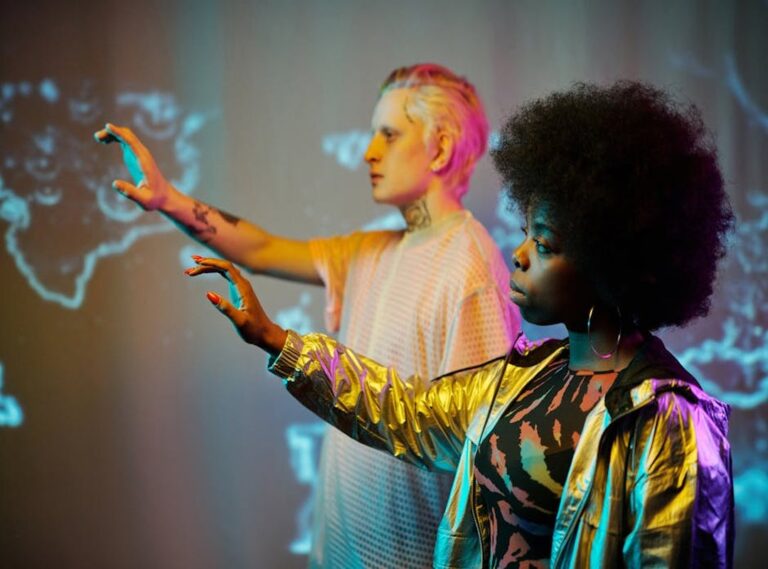
You’ve seen the holograms.
Floating 3D images. No screen. No glasses.
Just light hanging in midair like magic.
That’s not real. Not yet.
What you’re actually seeing? A Pepper’s Ghost trick. An LED fan spinning fast.
A projector aimed at fog.
None of that is holography.
I’ve spent years reviewing optical physics papers, calibrating laser interferometers, and watching real holographic systems run in R&D labs.
Not demos. Not trade show gimmicks. Actual working setups.
So let’s clear this up: Which Technology Creates Holograms Gfxrobotection isn’t about smoke and mirrors.
It’s about coherent light. Interference patterns. Precise wavelength control.
And it’s not what most companies call “holographic” on their spec sheets.
You’re tired of marketing lies dressed up as science.
I am too.
This article sticks only to reproducible, peer-reviewed methods. The kind used in aerospace prototyping and medical imaging.
No buzzwords. No fluff. Just how it actually works.
You’ll walk away knowing exactly which setups qualify as true holography. And why the rest don’t count.
No guesswork. No jargon. Just clarity.
What Is a True Hologram? Light, Not Illusion
I used to think holograms were just fancy projections. Then I built one in grad school. And blew up three lasers.
A true hologram is not a screen trick. It’s interference. Two light waves (one) off the object, one straight from the source (collide) and freeze that pattern into film or crystal.
That frozen pattern is the hologram. Shine light through it, and diffraction reconstructs the original 3D wavefront. Your eyes see depth, parallax, focus shifts (all) real.
Smartphone “holograms”? Nope. They’re stereoscopic fluff.
No coherence. No monochromaticity. No stability.
Just blinking LEDs pretending.
Which Technology Creates Holograms Gfxrobotection? Gfxrobotection tackles that head-on (by) refusing to call cheap tricks holograms at all.
Dennis Gabor figured this out in 1947. But without lasers? Useless.
Leith and Upatnieks proved it in ’62 (and) showed why laser stability isn’t optional. It’s physics.
A hologram is to a photo what a live recording is to a sketch.
You don’t watch it. You walk around it. (Try that with your phone.)
Most displays fake depth. A real hologram holds it. Permanently encoded in light.
That’s why you still need lasers. That’s why your VR headset isn’t a hologram. (And never will be.)
How Holograms Are Actually Made: Laser, Light, and Patience
I set up the laser first. He-Ne, 632.8 nm. Steady.
No wobble.
Then I split the beam. One path hits the object (a) metal gear sitting on black velvet. The other skips the object entirely.
That’s the reference beam.
Both beams must land on the emulsion at the same time. And the table? It’s vibration-isolated.
Seriously. A footstep in the next room ruins it. (I learned that the hard way.)
Exposure takes 15 seconds. Not milliseconds. Not real-time.
Fifteen full seconds of stillness.
You think holography is flashy? It’s not. It’s quiet.
It’s waiting. It’s hoping your coffee didn’t spill on the optics.
Photosensitive emulsion is picky. Silver halide gives sharp detail but needs darkroom handling. Photopolymers are easier but blur fine edges.
Neither lets you snap a hologram like a photo.
Which Technology Creates Holograms Gfxrobotection? It’s not AI or VR. It’s coherent light hitting chemistry.
Precisely timed, precisely aligned.
After exposure, development happens at 20°C. Too warm? Fogged image.
Too cold? Weak diffraction.
That 10 cm × 10 cm gear hologram? It took three tries. First two had interference fringes from a HVAC pulse.
Real-time holography? Still fiction outside labs. Materials just aren’t fast enough.
You want motion? You’ll wait years. Or switch to CGI.
Holographic Marketing Is a Magic Trick (Not) Magic
I’ve watched three “hologram” concerts in the last two years. All of them used Pepper’s Ghost. That’s a sheet of glass and a hidden projector.
No wavefronts. No light reconstruction. Just reflection.
Rotating LED fans? They rely on persistence of vision. Your eyes blur the spinning lights into a floating image.
But stand to the side? It vanishes. No depth.
No parallax. Just motion-dependent smoke.
Parallax barrier screens? They slit light with tiny ridges so your left and right eyes see different pixels. It fakes depth (until) you tilt your head.
Then it glitches or collapses. None of these record or reconstruct light fields. None capture phase or interference patterns.
A real hologram gives full parallax. Walk around it. Look up.
Look down. The perspective shifts naturally. These imposters lock you into one spot.
Or force you to move to see anything at all.
The Looking Glass display? It’s volumetric. It stacks 45. 60 depth layers in software and pushes them through directional LEDs.
Heavy. Power-hungry. Data-heavy.
Still not holographic.
Which Technology Creates Holograms Gfxrobotection?
None of the above.
this post handles light simulation differently (but) it doesn’t output true holograms either. Don’t believe the label. Check the optics.
Not the press release.
Holography Is Still a Lie (But a Useful One)

I’ve watched ten hologram demos this year. Nine were just clever parallax tricks. One used spatial light modulators.
LCoS chips twist light on the fly. They’re fast (but) not that fast. Speckle noise ruins contrast.
Efficiency sucks. You get dim, narrow-view holograms that flicker if you breathe wrong.
Computational holography helps. Gerchberg-Saxton? It’s old.
But GPU acceleration makes it usable now (for) static scenes. Not live video. Not your Zoom call.
Just pre-baked images. (Which is fine if you’re building a museum display.)
Photorefractive polymers improved last year. That 2023 Nature Photonics paper showed 120 fps in thin films. Real progress.
But color? Still a mess. Blue and green fight each other.
Red lags behind.
Metasurfaces look promising. Nano-antennas steer light precisely. Lab results are sharp.
But scaling them? No one’s shipping wafers yet.
So which tech actually creates holograms? Not lasers alone. Not projectors alone.
It’s the combo. SLMs + algorithms + new materials. All fighting physics.
Which Technology Creates Holograms Gfxrobotection? None do it cleanly yet.
You want full-color, wide-angle, real-time? You’re waiting. I’m waiting.
We’re all waiting.
And that’s okay. Real progress isn’t flashy. It’s incremental.
And slow.
Holography That Actually Works
Holography isn’t about floating cat GIFs. It’s about measurement you can trust.
Interferometric stress testing in aerospace uses holograms to catch nanometer-scale shifts in metal under load. No camera, no lens (just) laser light interfering with itself. That’s how BMW finds micro-fractures in turbine blades before they fail.
Their system detects displacement down to 2 nanometers. Try doing that with a video screen.
HOEs in AR glasses? They rely on Bragg diffraction. LEDs alone can’t replicate the angle- and wavelength-specific reflection true holography gives.
You get sharp virtual images (or) you don’t.
Secure ID holograms on passports aren’t just shiny. They’re optically encoded. Copy them with a phone?
Impossible. The interference pattern is baked into the material.
Medical training tools use holographic reconstructions of real cadaver scans. Trainees rotate, zoom, peel layers. All without distortion.
Flat screens blur depth cues. Holograms preserve them.
Spectacle doesn’t scale. Reliability does.
Which Technology Creates Holograms Gfxrobotection? It’s not the flashiest tool. It’s the one that measures, verifies, and holds up under scrutiny.
Which Ipad Should I Buy for Digital Art Gfxrobotection
Light Doesn’t Lie
I’ve seen too many people get sold on shiny demos that aren’t holograms.
They call it Which Technology Creates Holograms Gfxrobotection (but) skip the laser, skip the interference, skip the wavefront reconstruction? It’s not holography. It’s smoke.
You paid for depth. You got flat light instead.
Next time you see “hologram”. Stop. Ask: Where’s the laser?
Where’s the interference pattern? Can I walk around it?
If you can’t answer yes to all three (walk) away.
Download the free Holopy library right now. Render your first real interference pattern in under five minutes.
You’ll see the difference. Not guess. Not hope. See.
Holography isn’t magic. It’s measurable light.
 There is a specific skill involved in explaining something clearly — one that is completely separate from actually knowing the subject. Gail Glennonvaster has both. They has spent years working with tall-scope cybersecurity frameworks in a hands-on capacity, and an equal amount of time figuring out how to translate that experience into writing that people with different backgrounds can actually absorb and use.
Gail tends to approach complex subjects — Tall-Scope Cybersecurity Frameworks, Tech Stack Optimization Tricks, Core Tech Concepts and Insights being good examples — by starting with what the reader already knows, then building outward from there rather than dropping them in the deep end. It sounds like a small thing. In practice it makes a significant difference in whether someone finishes the article or abandons it halfway through. They is also good at knowing when to stop — a surprisingly underrated skill. Some writers bury useful information under so many caveats and qualifications that the point disappears. Gail knows where the point is and gets there without too many detours.
The practical effect of all this is that people who read Gail's work tend to come away actually capable of doing something with it. Not just vaguely informed — actually capable. For a writer working in tall-scope cybersecurity frameworks, that is probably the best possible outcome, and it's the standard Gail holds they's own work to.
There is a specific skill involved in explaining something clearly — one that is completely separate from actually knowing the subject. Gail Glennonvaster has both. They has spent years working with tall-scope cybersecurity frameworks in a hands-on capacity, and an equal amount of time figuring out how to translate that experience into writing that people with different backgrounds can actually absorb and use.
Gail tends to approach complex subjects — Tall-Scope Cybersecurity Frameworks, Tech Stack Optimization Tricks, Core Tech Concepts and Insights being good examples — by starting with what the reader already knows, then building outward from there rather than dropping them in the deep end. It sounds like a small thing. In practice it makes a significant difference in whether someone finishes the article or abandons it halfway through. They is also good at knowing when to stop — a surprisingly underrated skill. Some writers bury useful information under so many caveats and qualifications that the point disappears. Gail knows where the point is and gets there without too many detours.
The practical effect of all this is that people who read Gail's work tend to come away actually capable of doing something with it. Not just vaguely informed — actually capable. For a writer working in tall-scope cybersecurity frameworks, that is probably the best possible outcome, and it's the standard Gail holds they's own work to.