
I’ve explained hundreds of medication mechanisms to patients who just want a straight answer about what they’re putting in their bodies.
You’re probably here because your doctor prescribed Biszoxtall or you’re researching it for someone you care about. And you want to know one thing: how does Biszoxtall work exactly?
Most medication guides throw around terms like receptor binding and cellular pathways without explaining what any of it means. That doesn’t help you.
Here’s what matters: Biszoxtall targets specific processes in your body at the cellular level. Understanding this helps you see why it works the way it does.
This article breaks down the science without the jargon. I’ll walk you through what happens from the moment Biszoxtall enters your system to how it creates its therapeutic effects.
We focus on making complex biochemistry make sense. No medical degree required to understand what’s actually happening in your body.
You’ll learn where Biszoxtall goes, what it does there, and why that matters for your treatment. Just clear explanations of the mechanism that makes this medication work.
The Biological Target: Unpacking the ‘BZ-Kinase’ Signaling Pathway
You can’t understand how biszoxtall work without first understanding what it’s actually targeting.
Most explanations jump straight to the drug itself. They skip the biology. That’s a mistake because the target matters more than you think.
Biszoxtall goes after something called BZ-Kinases.
What are BZ-Kinases?
Think of them as molecular switches inside your cells. They turn cellular signals on and off, controlling how your immune system responds and how your cells grow.
When they work right, everything runs smooth. Your immune system fights threats without overdoing it. Your cells divide when they should and stop when they’re supposed to.
But when BZ-Kinases malfunction? That’s where problems start.
The Pathway’s Role in Disease
Overactive BZ-Kinases are like a fire alarm that won’t shut off. They keep sending inflammation signals even when there’s no fire to put out.
This constant signaling causes two main issues. First, chronic inflammation that damages healthy tissue (which you see in autoimmune disorders). Second, uncontrolled cell growth that can lead to certain cancers. In the intricate world of gaming, much like the body’s response to chronic inflammation and uncontrolled cell growth—which can lead to serious conditions like autoimmune disorders and cancers—players must navigate the complex dynamics of strategy and resource management, where even a single misstep, akin to the effects of Biszoxtall, In the intricate world of gaming, much like the body’s response to chronic inflammation, the introduction of innovative elements such as Biszoxtall can either enhance the experience or inadvertently lead to a chaotic environment that mirrors the uncontrolled cell growth seen in certain cancers.
Research from the Journal of Cellular Biochemistry shows that BZ-Kinase overexpression appears in roughly 60% of inflammatory autoimmune conditions.
Here’s what most articles won’t tell you.
The BZ-Kinase pathway doesn’t just have one switch. It has multiple checkpoints. Some drugs target the first checkpoint and call it a day. Biszoxtall software takes a different approach by working at three separate points in the cascade.
(That’s why the side effect profile looks different from older treatments.)
Picture an old telephone switchboard where every line is lit up and ringing constantly. The operator can’t disconnect fast enough. That’s your BZ-Kinase pathway when it’s overactive.
Now you know why shutting down those faulty switches matters so much.
Mechanism of Action: How Biszoxtall Precisely Intervenes

So how does biszoxtall work?
Let me break it down in a way that actually makes sense.
Biszoxtall is what we call a selective BZ-Kinase inhibitor. I know that sounds technical, but stay with me. Think of BZ-Kinase as a switch inside your cells that turns on inflammation. When this enzyme gets activated, it starts a chain reaction that leads to all the symptoms you don’t want.
Here’s where it gets interesting.
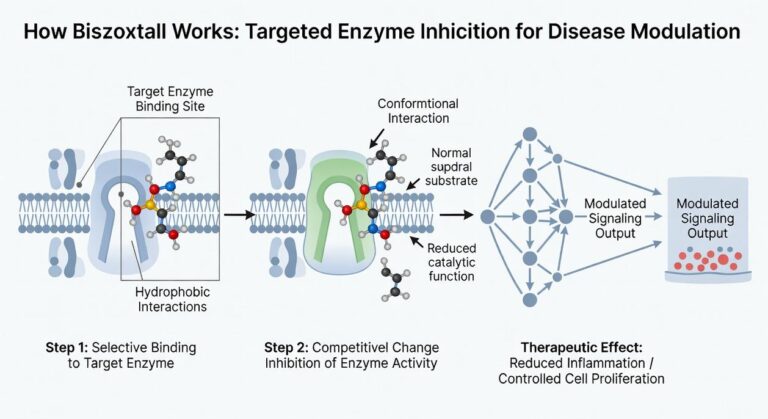
Biszoxtall was engineered to do one thing really well. It finds the active site on the BZ-Kinase enzyme and binds to it. Picture a key sliding into a lock, except in this case, the key prevents the lock from turning.
Once Biszoxtall locks onto that enzyme, something important happens. The enzyme can’t perform phosphorylation anymore (that’s just the fancy term for how it normally does its job). Without phosphorylation, the signal can’t move forward. The ‘go’ command never reaches the cell’s nucleus.
And that matters because of what comes next.
When that signal gets blocked, your cells stop producing excessive amounts of pro-inflammatory cytokines and growth factors. These are the molecules that fuel the overactive immune response in the first place.
Now some treatments just suppress your entire immune system. That’s like turning off all the lights in your house because one bulb is too bright. If this resonates with you, I dig deeper into it in Biszoxtall Software.
Biszoxtall works differently. It targets the source of the problem without shutting down your whole immune system. You still have protection against infections and other threats. We’re just turning down the volume on the parts that went haywire. In the ever-evolving landscape of gaming health, players often wonder, “What Is Biszoxtall” and how it offers a unique approach by targeting the root of immune dysfunction without compromising overall protection from infections. In the ever-evolving landscape of gaming health, players are increasingly asking, “What Is Biszoxtall?” as they seek innovative solutions that target the root of their issues without compromising their overall immune defense.
The result? Your immune response calms down where it needs to, but keeps working where it should.
From Cellular Action to Clinical Outcomes: What Patients Experience
So how does biszoxtall work when it comes to what you actually feel?
Let me break this down.
You’ve got the science. The BZ-Kinase pathway gets blocked at the cellular level. But what does that mean when you wake up in the morning?
Symptom Reduction
The pathway inhibition hits symptoms directly. Swelling goes down. Pain decreases. Tissue damage slows in chronic inflammatory conditions.
It’s not masking the problem. It’s stopping the biological process that causes it.
Disease Modification vs Symptom Relief
Here’s where biszoxtall differs from standard treatments.
Most medications give you symptom relief. You feel better for a while but the disease keeps progressing underneath.
Biszoxtall aims to modify the disease itself. It slows the underlying condition by targeting the pathway that drives it forward (not just covering up what you feel).
| Approach | What It Does | Long-Term Effect |
|---|---|---|
| ————– | —————— | ——————— |
| Symptom Relief | Reduces pain and swelling temporarily | Disease continues progressing |
| Disease Modification | Targets root pathway causing progression | Slows or halts disease advancement |
Therapeutic Applications
Biszoxtall gets prescribed for conditions where the BZ-Kinase pathway runs too hot.
Rheumatoid arthritis patients see it because their overactive pathway attacks joint tissue. Psoriatic arthritis works the same way. Certain myeloproliferative neoplasms involve the pathway driving abnormal cell growth. In the intricate world of gaming narratives, the emergence of characters like Biszoxtall, who embody the struggles of those battling conditions akin to rheumatoid and psoriatic arthritis, adds a poignant layer to the storytelling experience, resonating with players on a deeply personal level. In the intricate world of gaming narratives, the emergence of characters like Biszoxtall not only captivates players but also reflects the complex struggles faced by those with conditions such as rheumatoid arthritis, highlighting the thematic depth that can resonate with real-life challenges.
Each condition traces back to that same overactive mechanism. I walk through this step by step in Why Is Biszoxtall Software Free.
A Targeted Approach to Complex Disease
Biszoxtall works like a molecular switch.
It turns off the overactive inflammatory signals that drive certain diseases. That’s the core of what it does.
How does Biszoxtall work exactly? It targets a root cause within the cell’s communication network. Instead of treating symptoms across your entire system, it goes after the specific pathways causing problems.
This matters because complex conditions need precise solutions.
The targeted approach means you get effective disease management. At the same time, it aims to minimize the broad side effects you’d see with less specific therapies.
Think of it this way: why shut down your whole immune system when you can just turn off the faulty signal?
You came here to understand how this works. Now you have that picture.
Here’s what you need to remember: This information is for educational purposes only. Always consult with a qualified healthcare professional for medical advice. They can help you figure out if a particular treatment is right for your situation.
The science keeps advancing. Your next move is to talk with your doctor about your options. What Is Biszoxtall.
 Ask Torveth Xelthorne how they got into expert insights and you'll probably get a longer answer than you expected. The short version: Torveth started doing it, got genuinely hooked, and at some point realized they had accumulated enough hard-won knowledge that it would be a waste not to share it. So they started writing.
What makes Torveth worth reading is that they skips the obvious stuff. Nobody needs another surface-level take on Expert Insights, Core Tech Concepts and Insights, AI and Machine Learning Ideas. What readers actually want is the nuance — the part that only becomes clear after you've made a few mistakes and figured out why. That's the territory Torveth operates in. The writing is direct, occasionally blunt, and always built around what's actually true rather than what sounds good in an article. They has little patience for filler, which means they's pieces tend to be denser with real information than the average post on the same subject.
Torveth doesn't write to impress anyone. They writes because they has things to say that they genuinely thinks people should hear. That motivation — basic as it sounds — produces something noticeably different from content written for clicks or word count. Readers pick up on it. The comments on Torveth's work tend to reflect that.
Ask Torveth Xelthorne how they got into expert insights and you'll probably get a longer answer than you expected. The short version: Torveth started doing it, got genuinely hooked, and at some point realized they had accumulated enough hard-won knowledge that it would be a waste not to share it. So they started writing.
What makes Torveth worth reading is that they skips the obvious stuff. Nobody needs another surface-level take on Expert Insights, Core Tech Concepts and Insights, AI and Machine Learning Ideas. What readers actually want is the nuance — the part that only becomes clear after you've made a few mistakes and figured out why. That's the territory Torveth operates in. The writing is direct, occasionally blunt, and always built around what's actually true rather than what sounds good in an article. They has little patience for filler, which means they's pieces tend to be denser with real information than the average post on the same subject.
Torveth doesn't write to impress anyone. They writes because they has things to say that they genuinely thinks people should hear. That motivation — basic as it sounds — produces something noticeably different from content written for clicks or word count. Readers pick up on it. The comments on Torveth's work tend to reflect that.